
You make a material fire-retardant by applying a flame-retardant product suited to its nature: spraying until saturation and run-off for textiles and artificial foliage, immersion in a bath for solid wood, an intumescent primer-and-topcoat system for wood left visible. Each product-substrate pair has its own LNE classification test report; outside that scope, no classification can be claimed.
The secrets of flame retardants
When working with flammable materials or looking to reinforce fire safety in your professional spaces, it is essential to know how to make a material fire-retardant. The use of flame retardants is crucial in transforming flammable materials into fire-retardant ones, providing effective protection against fires. Let’s explore the basics of fire-retardant treatment and the types of fire-retardant treatment products available to help you protect your environment.
Understanding fire-retardant treatment
Fire-retardant treatment is an essential technical process that involves treating a material to make it resistant to ignition or to reduce its combustion rate. This treatment aims to modify the properties of the material so that it is more resistant to flames and slows down its combustion rate. In other words, fire-retardant treatment helps minimize the spread of flames and controls how the material burns when exposed to a heat source or fire. This is typically accomplished by using specially designed anti-flammable products, which can be applied directly to the material or incorporated during its manufacture.
Fire-retardant treatment is a crucial preventative measure to improve fire safety, reducing the risk of fire spreading and providing valuable time for evacuation and management of emergency situations. By reinforcing the fire resistance of materials, we contribute significantly to the protection of structures and occupants from the dangers of fire.
Making a material fire-retardant with flame retardants
There are several types of flame retardants on the market, each suited to specific applications and materials. Choosing the appropriate flame retardant depends on the type of material you want to protect, the application, and current fire safety standards. Before making a material flame retardant, it is essential to understand the characteristics of the base material and review the specifications of the flame retardant to ensure it meets your needs. Here are some of our products offered for sale to make your materials fire-retardant.
-
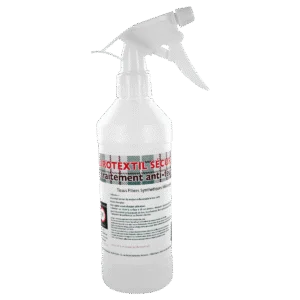 Fire retardant textile – Eurotextil47,00 € HT
 -
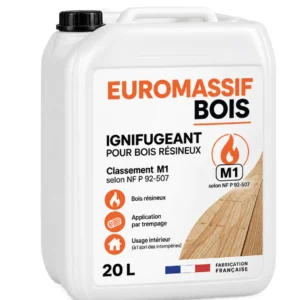 Fire retardant for wood – EUROMASSIF BOIS48,60 € HT
 -
 Flame retardant artificial plants – Euroflor51,20 € HT
Tips for applying flame retardants
L’application de produits ignifugeants doit être effectuée avec soin pour garantir une protection efficace. Le matériau à ignifuger doit être brut, si vous souhaitez le peindre, il faudra vous tourner vers des peintures anti feu. Voici quelques conseils à suivre :
- Calculate how many sprayers you will need. For this, you must know at least the surface area to be treated. For fabric, you will also need to know the weight of the fabric. We provide this information on each product sheet.
- Clean and dry the surface well.
- Spray the flame retardant on all surfaces of the material.
- Treat all sides well except those which are not accessible and/or visible (panel fixed against a wall, interior of an object, etc.).
- Leave to dry between 12 and 72 hours, depending on the temperature and humidity—naturally or accelerated.
For more information, contact us.