Opera and safety: how we treat the sets of the Aix-en-Provence Festival to class M1
Key points
- A prestigious historic setting: founded in 1948, the Aix-en-Provence Festival demands impeccable safety for performances held in the courtyard of the former archbishop’s palace.
- The technical challenge: treating a wide range of materials (kilometres of rope, artificial foliage) without altering the look of the sets or the way the crew handles them.
- Bespoke expertise: treatment by immersion and by spraying, carried out in our workshops, with controlled drying to protect the materials.
- Class M1: once the treatment is done we draw up the application declaration, which goes to the safety commission together with the instructions for use and the classification report, for large-scale cultural events.
1. The Aix-en-Provence Festival
The Aix-en-Provence Festival is a world reference for opera and classical music. Beyond the artistic performance, every production involves rigorous safety logistics, not least for the sets.
Between wood, rope and plant elements, the materials in use are many, and they have to stand up to the heat of the stage lights. To keep everyone safe, class M1 (non-flammable) is an essential condition. Alfaflor steps in at exactly that point, to bring these structures up to standard.
2. Our mission: meeting the standard while preserving the look of the set
For a technical director or a set designer, what the audience sees under the lights comes first. The brief for our teams is clear: deliver M1 compliance while respecting the original appearance of the materials.
Whether it is rope or artificial foliage, our aim is for the treatment to be visually neutral. In practice: colours are not altered, and the ropes keep the suppleness the crew needs to handle them easily on stage. The set keeps exactly the look its creators imagined.
3. Behind the scenes at Alfaflor: two methods for two kinds of material
Every set has its own specifics. For the Aix Festival we applied two distinct protocols, to obtain maximum effectiveness without compromising the visual result.
Treating the ropes:The precision of dipping For the kilometres of technical rope used on stage, spraying is not enough. We work by dipping (full immersion).
The result: this method lets our flame retardant EUROTEXTIL saturate the fibre right to the core of the rope. It is the only way to obtain an even M1 classification along the whole length, even on ropes under heavy tension.
The dose is calculated with the formula on the declaration: points = treated area (m²) × weight of the substrate (g/m²) × 0.2, with 200 points to one litre of product. Application is carried out to saturation, until the excess runs off.
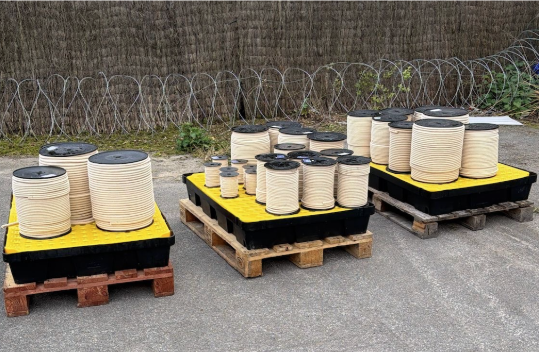
Caption: preparing the reels of rope
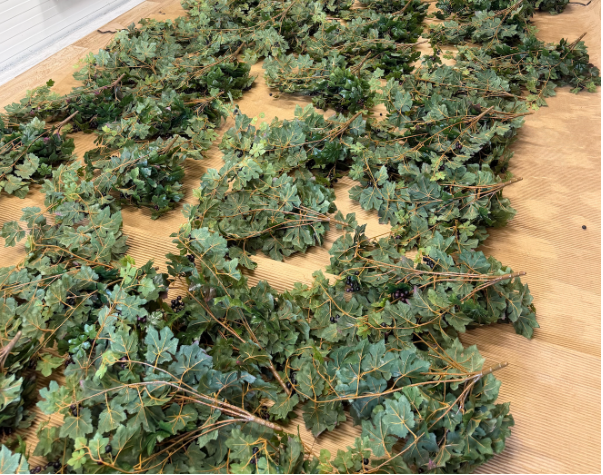
Treating the plant elements:Conversely, for artificial foliage and branches, we prefer spraying.
The result: spraying carried out to full saturation of the foliage, until the excess runs off, obtains class M1 under the conditions of the classification report, while keeping the suppleness of the plastic and the synthetic fabric. The set stays light, easy for the designers to handle, and keeps its natural look under the lights.
Why? As with the ropes, artificial foliage has to be impregnated to saturation and run-off: it is the quantity actually fixed on the fibre that determines the classification.
Caption: spray application on the artificial plants.
4. Why drying matters: the secret of a set that is ready for the stage
As our workshop set-up shows, flame-retardant treatment does not stop when the product has been applied. For delicate items such as artificial plants, we dry them flat on absorbent supports, with mechanical ventilation.
That stage is crucial in the performing arts: it stops the leaves sticking together in transit to Aix-en-Provence, and it keeps them supple so the set crew can hang them easily on the stage structures.
5. Why do the major festivals trust our expertise?
Running a festival on the scale of Aix-en-Provence means coordinating hundreds of suppliers. By entrusting the flame-retardant treatment of their sets to Alfaflor, the organisers buy themselves complete peace of mind:
Time saved: we treat large volumes at once in our workshops.
Dosing: we apply the quantities prescribed by the classification reports, to saturation of the substrate and run-off of the excess.
The file you are left with: we draw up the application declaration, which describes the job, the applying company and the characteristics of the treatment, and which will be presented to the safety commission on the night of the dress rehearsal.
6. Frequently asked questions about flame-retardant treatment
Does the treatment change the weight of the sets?
It is a common question from technical directors. Yes, the product adds mass (the protocol calls for a defined uptake of product), but after the full drying time we allow in the workshop the moisture evaporates and the change in weight becomes minimal, with no impact on the load calculations for theatre fly bars.
Is our flame-retardant classification report valid for open-air performances?
EUROTEXTIL is a hydroalcoholic solution, flammable and irritating to the eyes: it is applied in a ventilated area, away from any flame or heat source, under the conditions of use set out in its safety data sheet. Its classification report carries a durability not limited in time when sheltered from the weather, on articles that are neither washed nor dry-cleaned. Summer weather in Aix is exceptionally dry, but a set exposed to rain falls outside the scope of the report. For outdoor use, contact us: we will look at the right solution and, if a dedicated test is needed, how to set one up. Where a set has been exposed to rain, it falls outside the scope of the report and a new treatment would be necessary.
Can you step in urgently during the get-in?
Although workshop treatment is preferred for large volumes, Alfaflor has mobile teams able to work directly on the get-in stage or in the theatre’s construction workshops, treating last-minute items by spraying.