On-site treatment of artificial foliage and furnishings for bars and after-work venues
Key points
- The challenge for public entertainment venues: bars and nightlife venues are subject to strict regulations. Plant displays, floral ceilings and furnishings have to meet a reaction-to-fire requirement: for artificial floral decorations in premises open to the public, article AM 19 § 6 of the fire-safety regulation sets M2. Which article applies to your other furnishings is read in the regulation itself and assessed with your inspection body or the competent safety commission.
- No dismantling required: The Alfaflor team will come directly to your premises outside of your opening hours.
- Dual expertise: we have both the classified products and the know-how to treat both artificial plants and furniture.
- What you are left with: we carry out the treatment and hand over the file for the work done — the classification test report, the instructions for use, and the application certificate where the support treated is one of those covered by the tests; otherwise a treatment record stating the product used, the protocol followed and the quantities applied. On artificial foliage, the treated support obtains the M1 classification in the conditions of classification report no. P258195 – DEC/12, where article AM 19 § 6 sets M2 for artificial floral decorations: the classification obtained is above that requirement. The durability of that classification is stated by the report as follows: « NON LIMITEE : ARTICLE NON NETTOYABLE A SEC MAIS NON LAVABLE (MATÉRIAUX UTILISÉS À l’ABRI DES INTEMPÉRIES) » (translation for information; the French wording of the classification report prevails: not limited, the article being neither washable nor dry-cleanable, materials used sheltered from the weather). In practice the foliage is neither washed nor dry-cleaned, and is used away from the weather. On a plant display, only the artificial foliage at the grammages the report names falls within the classification: the moss, the backing, the frame, the trunks and the moulded stems do not, and natural or preserved plants are in none of our classification reports. For velvet it depends on the piece: velvet is a weave, not a fibre, so we ask for the composition and the surface mass before accepting the work. Seating is a case of its own: our textile report carries the mention « VALABLE POUR TOUTE APPLICATION NON COUVERTE PAR L’ART. AM18 §2 DE LA REGLEMENTATION ERP » (translation for information; the French wording prevails), and that article covers seats and floor coverings — so we treat your seats and hand over the treatment record for that work, but we attach no class from that report to a seat. Final compliance is assessed with your inspection body or the competent safety commission.
1. The ‘Jungle’ or ‘Cosy’ atmosphere: a charming feature, but a safety risk
Nowadays, the customer experience in an after-work bar is no longer limited to the cocktail menu. Visual immersion is key. Green walls, vines hanging from the ceiling and ultra-comfortable velvet sofas have become essential for attracting customers.
However, these decorative items (often made of plastics, synthetic foams or untreated fabrics) are highly flammable. In a public access building, where there is a high density of people and a festive atmosphere, the risk of fire is serious. Without the classification file for your decorations, the safety commission may require the immediate removal of your decorations, or even the administrative closure of the premises.
2. Alfaflor’s expertise: On-site fire-retardant treatment without disrupting your business
Taking down a wall-mounted green wall or moving 40 sofas into our workshops? That’s unthinkable for a bar manager. That’s why Alfaflor can carry out the work directly on site.
Our mission is simple: to keep your premises secure without hindering your turnover.
We will schedule our visit to suit your timetable (mornings or on days when you are closed).
Our technicians insulate sensitive areas (bar, bottles, floors).
We apply each product in the conditions of its own classification report, by spraying, whether to artificial plants or to upholstery fabrics that figure among the supports tested.
3. Case study no. 1: SAS B22 in Salon-de-Provence
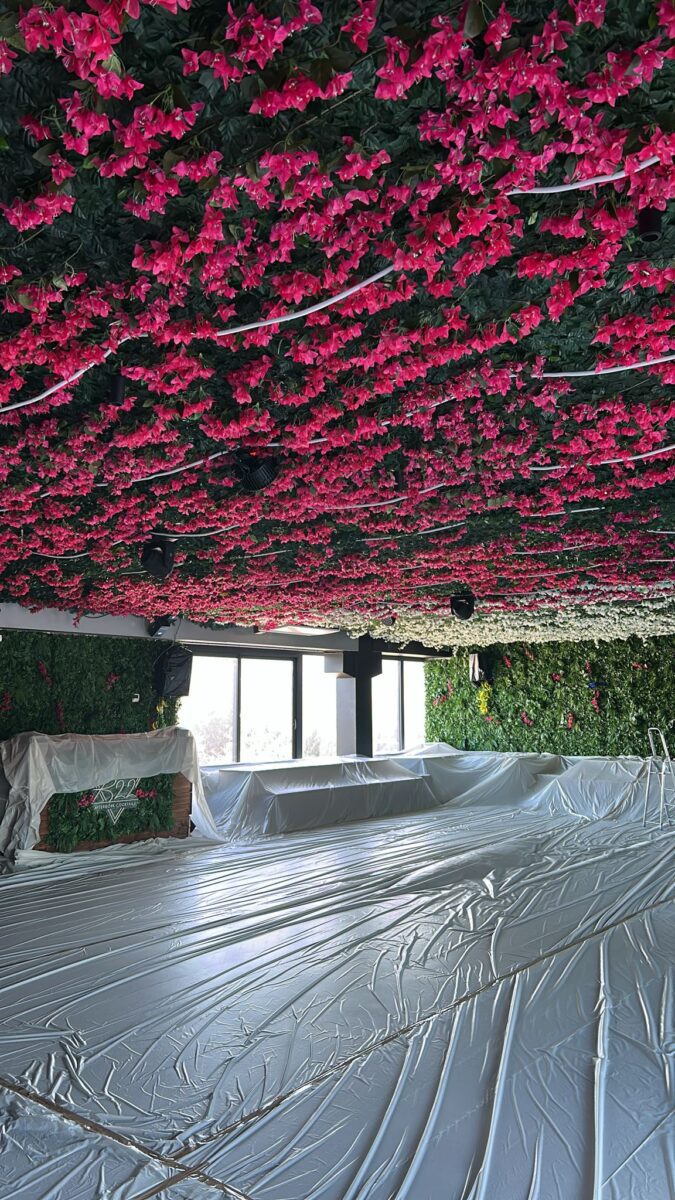
SAS B22 is a real institution when it comes to after-work drinks in Salon-de-Provence. To offer its customers an exceptional setting, the venue has opted for spectacular greenery.
The challenge: The bar is adorned with enormous artificial green walls and ceilings entirely covered in foliage. The challenge was to treat these vast, high surfaces without damaging the rest of the furniture or leaving any residue on the counter.
Our solution: Using our long-range spraying equipment and our specialist products for artificial plants, we were able to treat the entire décor evenly. SAS B22 was thus able to retain its unique atmosphere, with foliage treated according to the instructions for use: only the parts made of polypropylene 70 g/m² or polyester 175 g/m² fall within the M1 classification — on a composite display, the moss, the backing, the frame, the trunks and the moulded stems do not. A plant décor usually mixes several materials, and that is the first thing we look at on site.
4. Case study no. 2: O MAYA BAR
Treatment of the seating and greenery at the Omaya Bar, on site and outside opening hours.
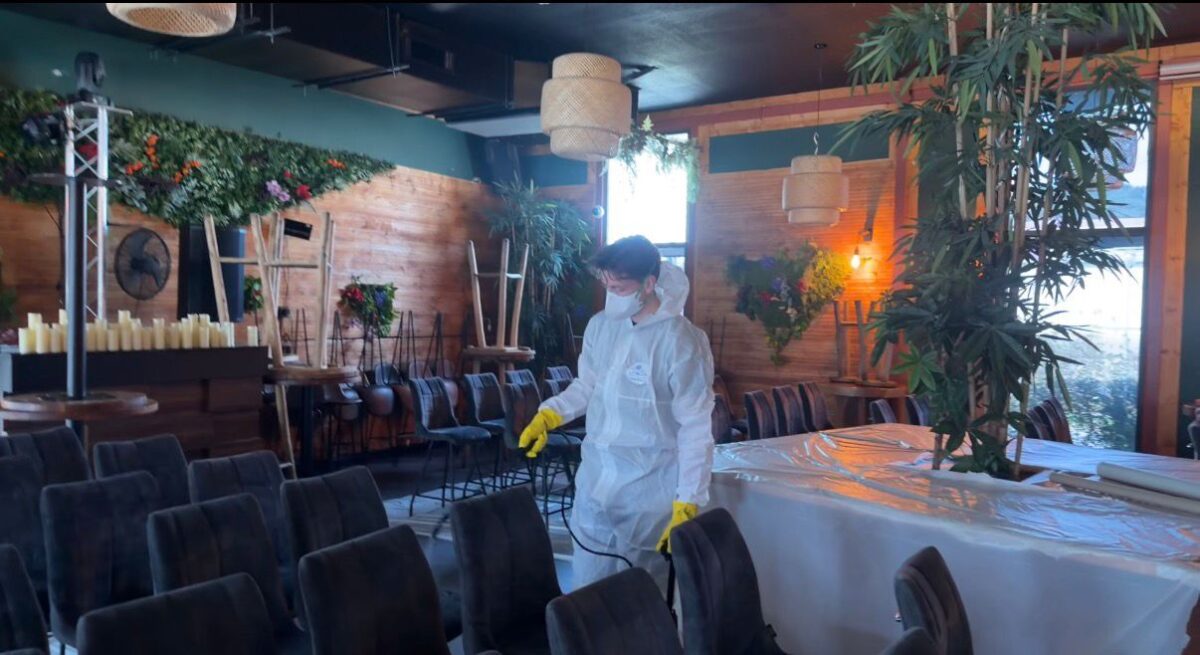
Located in a bustling business district, the OMAYA BAR is another must-visit spot for nightlife and after-work drinks. Their requirements were even more complex, as they involved both the décor and the furnishings.
The challenge: In addition to the artificial plants found throughout the venue, the Omaya Bar wanted to bring all its furniture – including fabric chairs and sofas – up to standard. This meant having to work with different materials during the same project.
Our solution: our teams applied two products in the same visit, each in the conditions of its own classification report — one for the artificial plants, one for the upholstery fabrics. On the foliage, where the part figures among the supports tested, the treated support obtains the classification stated by that report. On the seating, the work is carried out and recorded in a treatment record, but the classification of our textile report does not extend to it: that report is valid for applications not covered by article AM 18 § 2, and seats fall under that article, which has its own regime for the seat as a whole. We set that out in writing before starting, and the file handed over says for each element what is established and what is not. The work was carried out in a single visit.
5. Why should you entrust us with bringing your premises up to standard?
As a manager, your job is to welcome your customers, not to handle chemicals.
The right product on the right support: each material reacts differently, and each of our products has its own scope. Artificial foliage in polypropylene or polyester, and the textiles listed in their classification report, are within that scope; the moss, backings, frames, trunks and moulded stems of a plant display are not, and neither are natural or preserved plants. Velvet is settled piece by piece — it is a weave, not a fibre, and whether a given velvet is covered depends on what it is made of and how much it weighs, which is why we ask for the composition and the surface mass first. Seats and floor coverings are outside that scope as applications, whatever the fibre, because article AM 18 § 2 covers them and our textile report is valid for applications it does not cover. We say which is which before starting, and we apply the quantity the instructions for use provide.
Care taken with your premises: we protect your bar with tarpaulins and film, and clean up any traces of our work once we’ve finished.
The document side: the classification test report is issued by the laboratory, not by the applicator. Once the work is complete, Alfaflor completes, dates and signs the application certificate where the support treated figures among those tested — otherwise the treatment record — and sticks on the traceability labels. That file, with the instructions for use, is what the safety inspection team asks to see.
6. Frequently asked questions about our bar services
How long should the establishment allow for drying?
Two different durations, answering two different questions. For the classification, what matters is that the support dries to constant mass — the mass is the test, not the clock; on site that takes 12 to 72 hours depending on the support, the airflow and the ambient humidity. For your own reopening, we recommend allowing at least 72 hours of drying and airing, so the premises are ventilated before your customers return. Ideally, you should schedule our work to take place just before your consecutive days off.
Does the treatment leave a smell in the bar?
When applied, our products give off a normal technical odour. Once the recommended waiting time has elapsed and the premises have been thoroughly ventilated, the odour dissipates.
Will the product change the feel of my sofas?
Immediately after spraying, you may notice a slight sticky feeling on the upholstery, which is to be expected. Once it has dried completely, the fibres have absorbed the treatment and the seats recover their softness.
Will the appearance of my living walls change?
On artificial plants and foliage, our product leaves a subtle sheen. Far from detracting from your décor, this glossy finish often brings out the colours of your urban jungle.
Conclusion: set the mood, and we’ll take care of the rest!
Fitting out an after-work bar requires a significant investment in décor. Don’t risk having to dismantle everything during an inspection. With Alfaflor’s on-site service, you leave with the classification file for your fit-out — which is what your inspection body or the competent safety commission asks for.
Do you run a bar, restaurant or club and need to bring your décor up to standard?
Contact our experts to arrange a prompt and discreet visit to your premises.